Technical Approach
Why a small, local model
The model runs entirely on the laptop, which shaped the choices. The constraint is real: 4-bit CUDA training tooling does not run on Apple silicon at all, and 7 to 8B quantized weights plus optimizer state will not fit in 16GB shared with the OS; MLX does the same job (frozen quantized base, trainable adapters) natively on Metal, at a measured 1.1 GB peak. Small makes the result clearer, not weaker: a larger model already writes passable SQL, so fine-tuning moves it modestly, whereas a small coder model fails in exactly the ways LoRA fixes (wrong dialect, invented columns, malformed joins), so the base-versus-tuned gap is wider and the failure dump shows real schema errors, not formatting noise. And it stays offline: local inference means no per-query cost and no schema leaving the machine.
Fine-tuning with LoRA
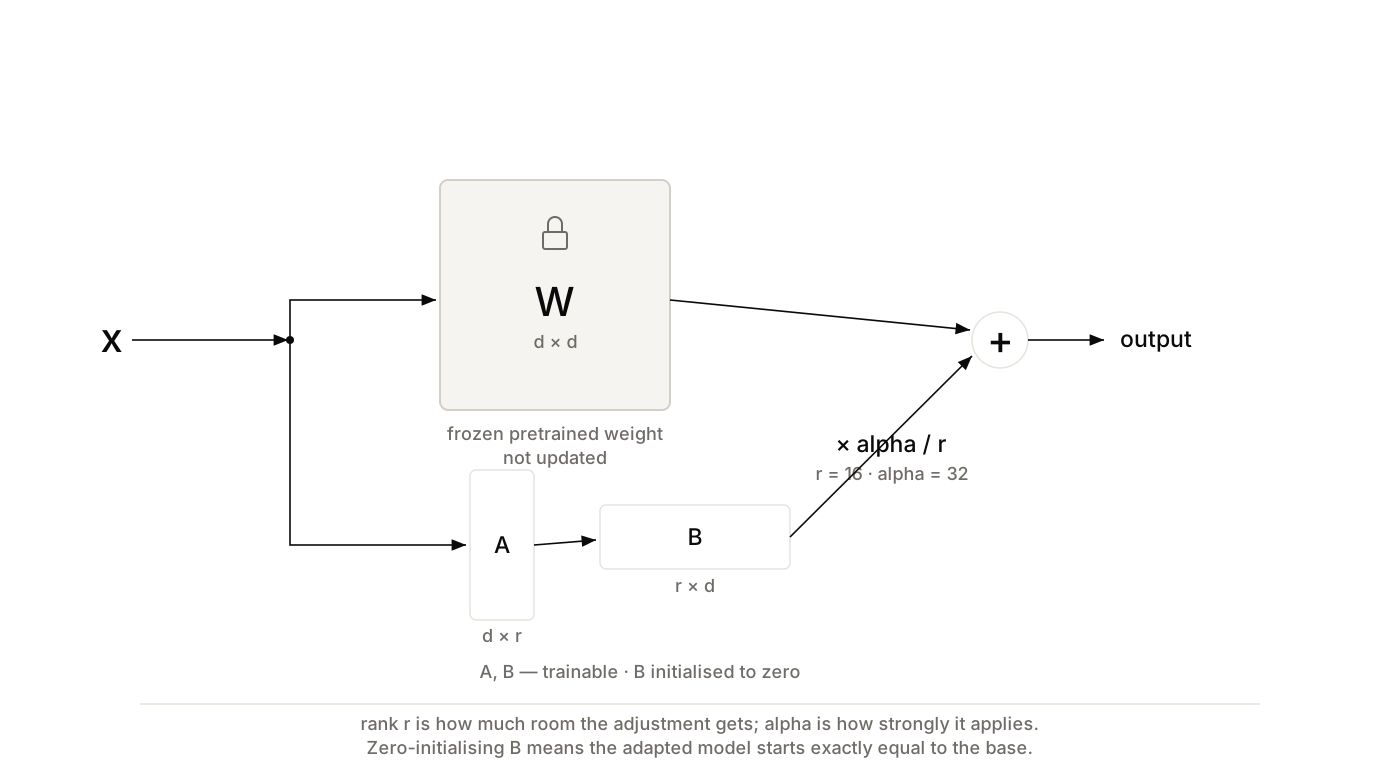
LoRA freezes the pretrained weight and trains two small matrices beside it, rank 16 on 8 layers, peak 1.1 GB, on a 16GB laptop.
No equations: the base weight matrix is frozen; two small matrices train beside it and are added to its
output. Rank is how much room the adjustment gets (16 here); alpha how
strongly it applies (32). B starts at zero, so the adapted model begins exactly equal to the
base and improves from there.
Three implementation choices mattered. The prompt template is a contract: one module imported by both training and serving, because if they drift the model is asked to work against a format it never saw and the failure looks like "the fine-tune didn't work" rather than "the prompt changed". Schema serialisation is a real trade: table and column names only, since types and sample rows roughly triple the token count for a modest gain and sequence length is the binding constraint in 16GB; the 73 of 7,000 examples over the cap (1.0%) are dropped and counted, never truncated, because a truncated example teaches the model to emit truncated SQL. The baseline is measured before training: 42.5% execution accuracy and 40% invalid SQL on 200 Spider dev examples, so the comparison cannot be quietly flattered after the fact.
The standard rule says watch validation loss; when it rises while training loss falls, you are overfitting, so stop. The run showed the exception. Validation (next-token) loss bottomed at iter 200 (1.41) and then climbed steadily to 2.09 at iter 2000, the textbook overfitting signal. But execution accuracy did the opposite: +0 points at 200 iters, +1 at 600, +5 at 2000. For a task metric, the language-modelling loss is the wrong early-stopping signal; you have to evaluate the task itself. Early-stopping on val loss would have shipped a model with no gain at all.
The guardrail: an AST allowlist, not a blocklist
A keyword blocklist was built first, and it failed 4 of 6 test cases in both directions at once.
Two false alarms: legitimate queries were refused because "delete" appeared inside a string
literal or a comment, where it has no power, and users blocked for no reason route around the tool, which is
how shadow database access starts. A bypass: CREATE TABLE passed because nobody
thought to list "create", and every new pattern is another round of whack-a-mole. A category it
cannot see: a blocklist of verbs says nothing about which tables you may read, so an ordinary
SELECT walks restricted data straight out.
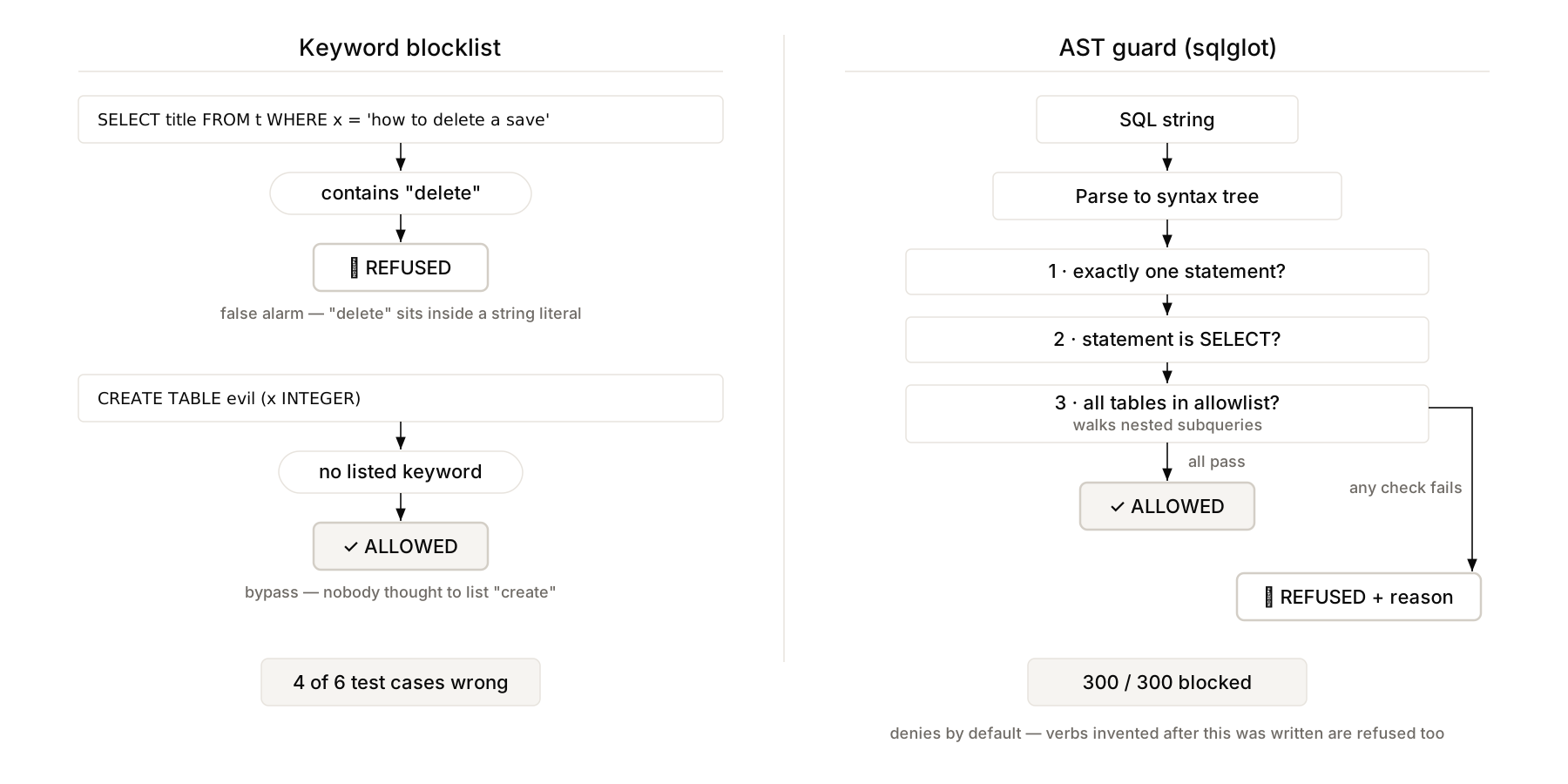
String matching inspects characters. What matters is structure, the blocklist got 4 of 6 wrong; the AST guard blocked 300 of 300.
Then the AST guard: parse with sqlglot, allow only a single SELECT touching
approved tables. The shift is from denying what you can think of to allowing only what you
approved, a verb invented after the code was written is refused by default. Because the parser walks
the whole tree, a restricted table reached through a nested subquery is caught for free. Measured: 300 of
300 red-team queries blocked across 20 databases, 100%. It also caught the fine-tuned model's own
mistakes: when the model emitted a malformed nested subquery, the guard refused it as unparseable rather
than executing garbage.
Calibrating the confidence score
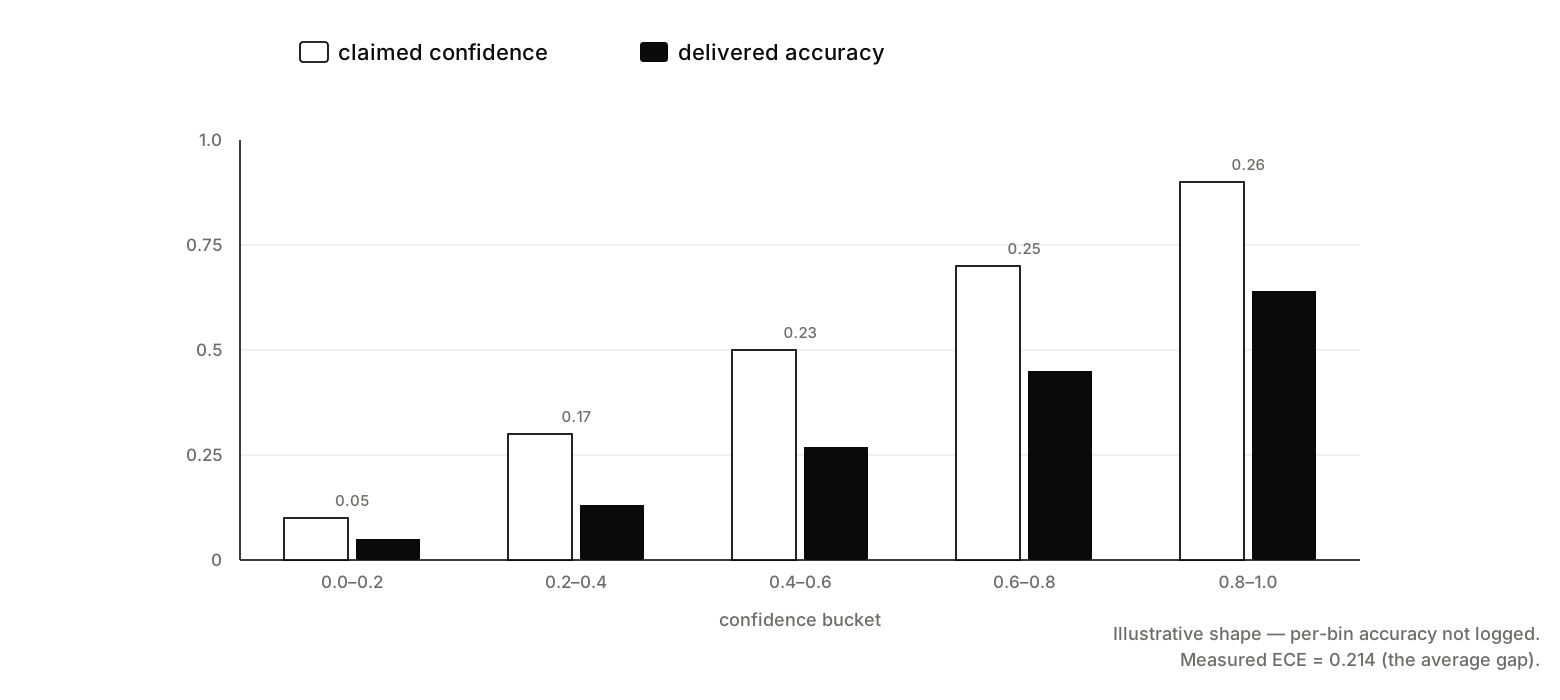
A confidence score is a promise. Calibration measures whether it is kept, bucket by bucket, because averages hide the failure. Measured ECE: 0.21.
The guard stops catastrophe. It does nothing about a safe SELECT that answers the wrong
question. So each query carries a confidence score, and anything below a threshold goes to a human. That
plan is sound only if the score means something. Calibration is whether it does;
ECE is the average gap between claimed and delivered confidence, measured in bins. Measured
here: ECE = 0.21, moderately miscalibrated, and honestly reported as such rather than assumed to be
trustworthy.