A hybrid Graph RAG system for long, mixed-format earnings-call transcripts, built on a LangGraph-style agentic loop that routes each query across vector search, financial tables, and a graph layer. An LLM-as-a-judge critic scores every answer against a grounding rubric and regenerates failures until they pass. The critic loop raised answers clearing the grounding bar from 62% to 91%, at about 88% agreement with human reviewers.
Earnings calls are core inputs for institutional due diligence, but each transcript can run 50 to 300 pages
of executive narrative, analyst Q&A, and financial tables. An analyst might ask "how did gross margin move
quarter over quarter, and why", a question that spans prose (the "why") and exact numbers (the "how much")
across several filings at once.
The system had to serve three shapes of that question, single-company Q&A, quarter-over-quarter narrative,
and peer benchmarking, all grounded in evidence. Plain retrieval struggles with each: top chunks capture
local semantics but miss cross-document and cross-quarter structure, values drift without table retrieval,
and a single-pass fetch cannot adapt to whether a question needs metrics, risks, or transcript tone.
The question was whether retrieval could move beyond chunk relevance into reliable, evidence-grounded
financial reasoning, and whether an automated critic could hold that grounding without a human checking
every answer.
Technical Approach
The three evidence layers
Three sources are integrated so one pipeline can do both semantic retrieval and symbolic reasoning.
A vector store (ChromaDB): transcript chunks embedded with all-MiniLM-L6-v2, filtered by
ticker, filing type, and quarter, with a quarter-relaxed fallback when an exact match is missing.
Structured Parquet tables: metrics, segment entries, and risk indicators under a shared
quarter normalisation, giving deterministic filters that anchor numeric outputs. A graph
layer: a company-quarter-metric entity schema in NetworkX with a Neo4j-compatible design, the
foundation for richer temporal and peer reasoning.
The agentic loop
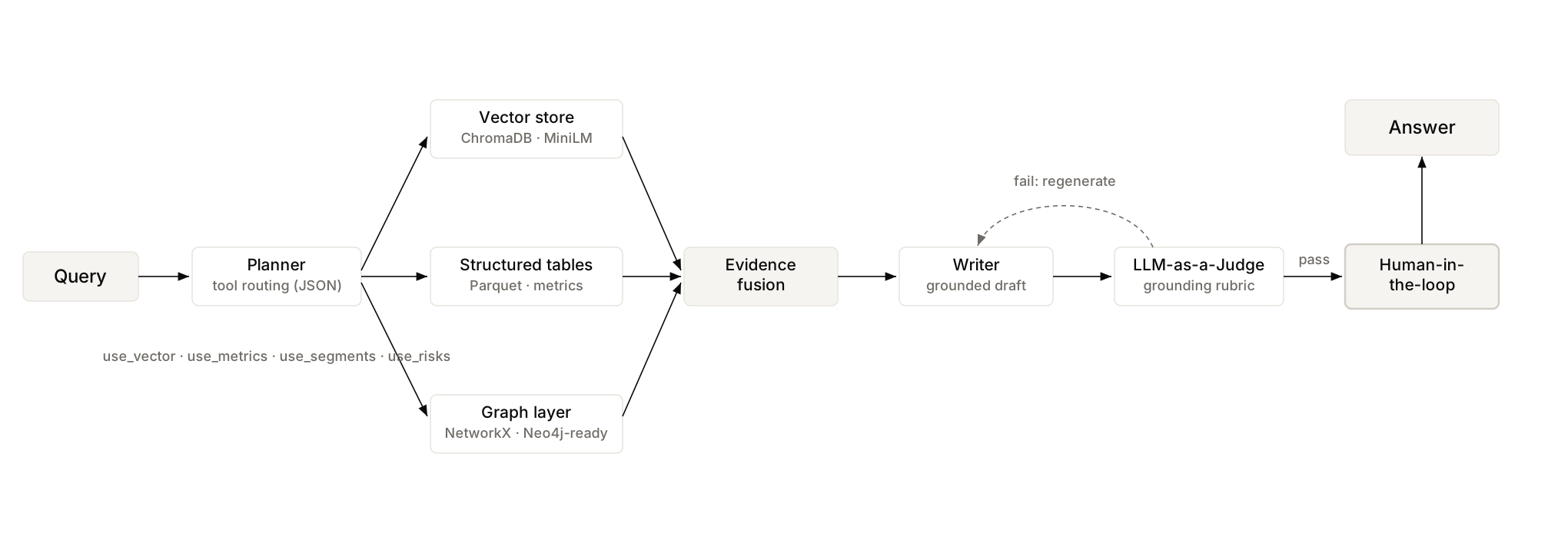
The pipeline runs as a LangGraph-style agentic loop. A planner model selects tools per query and returns a
JSON policy (use_vector_search, use_metrics, use_segments, use_risks, plus vector_query). Retrieved evidence
is fused into one JSON blob and passed to the response model with explicit grounding instructions, then
handed to an LLM-as-a-judge critic before anything reaches the analyst.
The agentic loop: a research agent gathers grounded context from document and live-data sources, a writer drafts, and an LLM-as-a-judge critic critiques and regenerates until the draft clears the rubric, with a human-in-the-loop checkpoint before anything ships.
Planner and tool routing: intent-aware retrieval selection, with a safe fallback to
all-tools mode when the planner output is invalid. Evidence fusion: transcript snippets,
metrics, segment data, and risk rows are combined into a single context package. The critic:
an LLM-as-a-judge scores each answer against a grounding, relevance, and completeness rubric and regenerates
any draft that fails until it clears the bar. Hallucination controls: low temperature and
explicit prompts to avoid guessing numbers when the data is absent.
Design choice: enforce the rubric at generation time
The same critic-and-regenerate philosophy as the agentic compliance work: a judge model enforces the
rubric while the answer is being written rather than trusting a single pass, so weak or ungrounded answers
are caught and rewritten before an analyst ever sees them.
Results
Each answer is scored by the LLM-as-a-judge critic on the rubric below. The critic held about 88% agreement
with human reviewers on pass/fail, and its regenerate-on-fail loop raised the share of answers clearing the
grounding bar from 62% on the first pass to 91%, cutting analyst verification by roughly 40% on assisted
queries. Tone and guidance synthesis were strong; strict numeric and temporal fact alignment remained the
hardest case.
A sample of the critic's per-answer rubric scores:
Case
Overall
Relevance
Factual
Grounded
Complete
Clear
Tone and guidance
1.0
1.0
1.0
1.0
1.0
1.0
Risk relevance
0.1
1.0
0.0
0.0
0.2
1.0
Main weakness
Numeric grounding and quarter attribution remain the dominant error source in difficult queries.
Next iteration priorities
Integrate domain-specific encoders such as FinBERT for financial retrieval quality.
Expand temporal graph logic for robust quarter-over-quarter reasoning.
Add citation verification and confidence calibration for hallucination mitigation.
Package as MCP-compatible service for modular analyst workflow integration.