The Decision That Triggered This Build
The spread of high-fidelity text-to-image models raised practical trust issues for online visual ecosystems:
attribution, misuse, and authenticity ambiguity. Existing detectors trained on curated benchmarks showed weak transfer
to noisy social data.
The core question was whether an end-to-end, continuously evaluated system could maintain reliable detection
performance on Reddit while also surfacing useful style and semantic context for human review.
Deployment reality
Open social streams are weakly labeled and constantly shifting; single-model accuracy alone is not enough for operational trust.
Methods
The pipeline has two major layers: automated data engineering and multimodal inference. Airflow orchestrates Reddit collection,
deduplication by submission ID, and metadata updates to BigQuery. Inference then runs CLIP (style), BLIP (caption), and SuSy (source).
Data pipeline
Scheduled collectors ingest new images, persist content to cloud storage, and append structured metadata tables for tracking and evaluation.
Transfer learning
SuSy was adapted from 6-class outputs to a 3-class projection layer, then fine-tuned end-to-end for Reddit-style domain adaptation.
Interpretability
Style rankings, captions, and class probabilities are surfaced together through a Gradio UI for rapid qualitative validation.
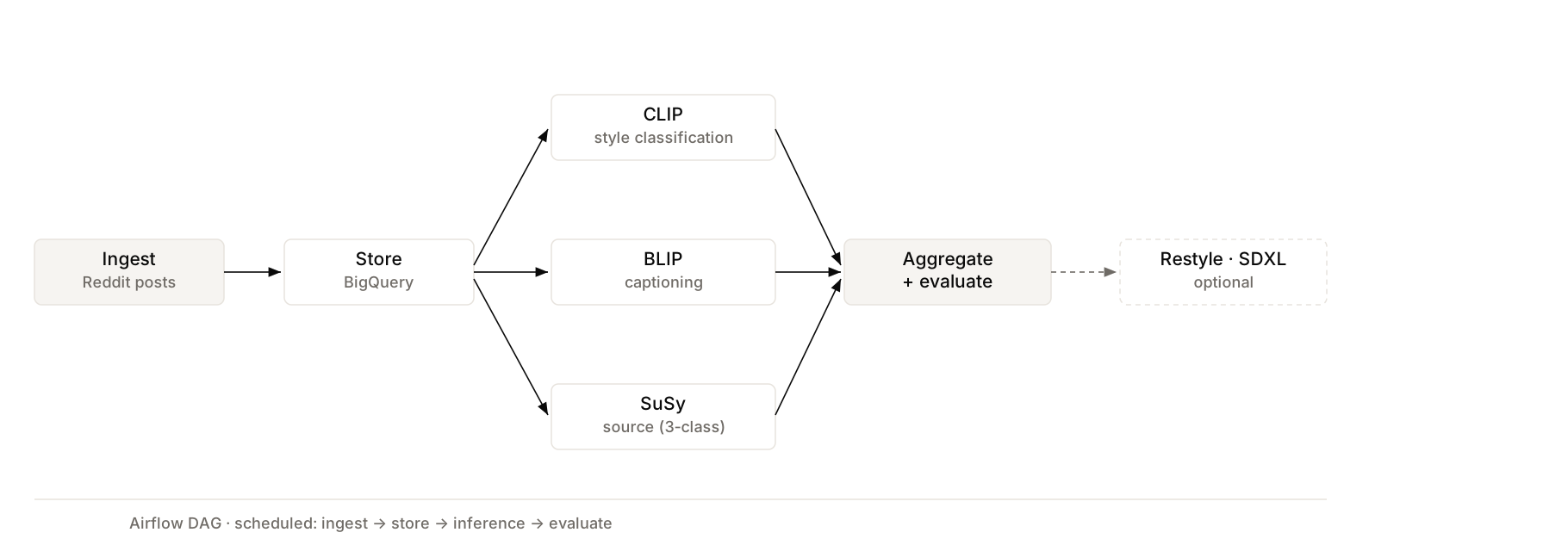
Figure 4: the Airflow DAG — scheduled ingestion into BigQuery, three parallel inference models, then aggregation and evaluation.
Experiments and Findings
Baseline CNNs (ResNet variants) underperformed on Reddit’s diverse artistic distributions. BLIP outperformed earlier captioning attempts on semantic richness,
and CLIP prompt engineering improved style ranking stability. The strongest gains came from SuSy transfer learning under domain shift.
| Class / Model |
Original SuSy |
Finetuned SuSy |
| Authentic |
68.22% |
57.71% |
| DALL-E |
0.32% |
14.38% |
| MidJourney |
0.28% |
43.37% |
Interpretation
Finetuning significantly increased AI-class detection quality on Reddit-like data, indicating that domain-adaptive heads are critical for real deployment.

Figure 6: BLIP-generated captions showing semantically rich image descriptions used for interpretability and restyling prompts.

Figure 8: Stable Diffusion XL image-to-image restyling guided by BLIP captions while preserving semantic structure.
System Overview
M(iche)Langelo is implemented in Python with PyTorch, Transformers, OpenCLIP, Diffusers, PRAW, Airflow, and BigQuery.
The architecture is modular, enabling continuous collection, scalable storage, and iterative model updates.
Continuous ingestion
Airflow + PRAW keep datasets fresh from active Reddit communities.
Multimodal inference
CLIP, BLIP, and SuSy provide style, semantic, and source signals in one pass.
Scalable analytics
BigQuery stores metadata, predictions, confidence scores, and execution traces.
Interactive inspection
Gradio UI enables rapid qualitative review and restyling workflows.

Figure 11: Interactive analysis UI with model options and execution controls.

Figure 12: Structured output panel combining caption, style ranking, and source-detection probabilities.

Figure 13: BigQuery sample rows showing pipeline outputs and model predictions.


